- Home
- Homes
Heating and cooling for houses in Cheektowaga
Gas furnaces and boilers, central air, heat pumps and ductwork — in a housing stock that was mostly built before anybody worried about how tight a house could get.
No heat
Diagnosed from the cheap end, in this order, because the things at the top fail most often and cost the least to put right.
Power and controls. The breaker, the service switch at the head of the basement stairs, the door interlock, and the thermostat with its batteries. A real share of first-cold-night calls end here and we say so rather than finding something else to charge for.
The one that looks like a light switch beside the basement door is the furnace service switch. It gets turned off by decorators, by children and by people carrying furniture.
Filter and airflow. A blocked filter trips the limit switch: the furnace lights, heats, shuts down and locks out. It reads exactly like a failure and it costs nothing to rule out.
Ignition and flame sensing. Igniter, flame sensor, pressure switch, and the condensate trap on a high-efficiency furnace. Most genuine faults live here and most of them are inexpensive.
Circulators and zone valves on a boiler. A zone that is cold while the others are warm is almost never the boiler — it is a circulator, a zone valve, a thermostat wire or an air lock.
Gas valve and board last, because they fail least and cost most. If we get there you see the reading that proves it before anything is ordered.
The heat exchanger is inspected on every no-heat call whatever the fault turned out to be. A cracked one ends the visit — the appliance is shut off and tagged, and no repair is attempted on it.
Gas, or a carbon monoxide alarm
Do not ring a contractor first. Get everybody out of the house and, from outside, call 911 and your gas utility’s emergency line. They arrive faster than any contractor, they do not charge you for a false alarm, and making the property safe is their job.
Ring us afterwards. Finding out why it happened and putting it right is ours.
What this housing stock adds
Cheektowaga is mostly post-war: ranches, capes and two-storeys built between about 1948 and 1975, with basements that were finished later and windows that were replaced at some point in the nineties or after.
Every one of those improvements tightened the house. New windows, new doors, blown insulation, sealed rim joists. All of it is worth doing and none of it is a mistake — but the furnace in the basement was designed on the assumption that the house leaked, and that its combustion air would simply arrive.
A clothes dryer, a bathroom fan and a range hood all throw air out of the house. In a tight basement with an atmospheric furnace and a water heater, they are competing with the flue.
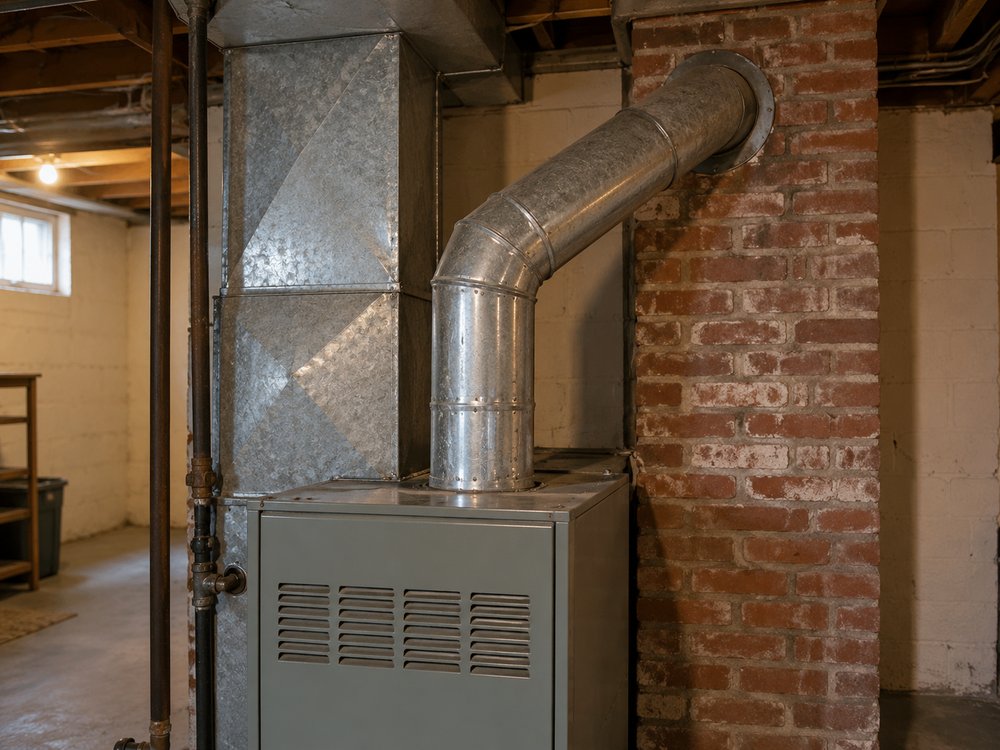
The symptom is rarely dramatic. A pilot that will not stay in. Rust streaks on the flue. Condensation on basement walls in winter. A smell in the first minute of a burn. Any of those is worth a look, and the look costs very little.
Most houses are fine. The point is that it is checkable, and almost nobody checks it — including on an annual service.
The room that never keeps up
The most common request we get, and the one most often answered with the wrong equipment. It is nearly always airflow: a branch added when a basement or an attic was finished, a crushed flexible run, a damper closed years ago, or a return duct far too small for the rooms it serves.
We measure static pressure across the system and the airflow at that register and at one that works. That turns an argument into two numbers on a page, and it usually identifies which of the four it is before anything is opened up.
An oversized furnace short-cycles, heats unevenly and tends to make the cold room slightly worse rather than better.
Replacing something
A quote here is built from a room-by-room heat loss calculation, the measured capacity of the existing ducts, the venting, and the electrical supply read off the plate of the proposed unit — not from the rating on the old one. Equipment fitted before about 2000 was routinely far too big.
You get one page with model numbers, capacities, what is being removed, what is being altered, and the price.
Going from an older furnace to a high-efficiency one changes the venting completely — and on a chimney shared with the water heater it changes that too. It belongs in the quote, not in a phone call on the day.